


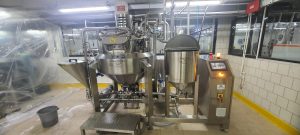


Filling machines package an enormous range of products, from thin liquids and sauces to pastes, creams, powders and granules. The right type depends on your product’s viscosity, whether it contains particles, the output you need and the level of automation your budget supports. This guide explains the main categories, how they work and where each one fits.
Al Hariri Group is among the leading manufacturers of filling and packaging equipment in Turkey. We supply complete lines to customers in the Gulf, Europe and Turkey, so we know which solutions perform well in day-to-day production.
- Automation level: manual, semi-automatic and fully automatic
- Volumetric or liquid-level filling: which principle fits?
- Liquid-level machines: siphon and overflow systems
- Volumetric machines: piston, pump and peristaltic fillers
- Other options: timed gravity, net weight and servo pump fillers
- Counter-pressure fillers for carbonated drinks
- Choosing the right filling machine
- Frequently asked questions
Automation level: manual, semi-automatic and fully automatic
Manual fillers are operated by hand and need no electrical supply. They suit creams, gels, shampoos and medium-viscosity liquids in small batches or laboratory work. They are more accurate and faster than pouring by hand, but output depends on the operator.
Semi-automatic fillers speed up the cycle for small and medium runs. An operator positions containers or starts each cycle, while the machine measures and dispenses. They handle a wide range of liquids and are a sensible next step for a growing business.
Fully automatic lines run on variable-speed conveyors with sensors and programmable controls. They suit high-volume production and every viscosity level, including liquids with suspended particles. Filling heads can be added to raise output. This is the category where Al Hariri Group focuses most of its production.
Volumetric or liquid-level filling: which principle fits?
Every filling system works on one of two principles. Volumetric fillers dispense a set volume each cycle, so every container receives the same quantity. Liquid-level fillers fill each container to the same height, so volumes can vary slightly.
Liquid-level filling is usually faster and less costly, and for most consumer products it is the sensible choice because containers look evenly filled on the shelf. Volumetric filling is the better option when dosing must be exact, as in pharmaceuticals, or when the product is expensive per unit and small overfills add up at high volumes.
Liquid-level machines: siphon and overflow systems
Siphon filling is one of the simplest methods. Gravity moves product from a tank through a valve, and a siphon starts the flow into the container. An adjustable bottle rest sets the fill height, so containers cannot overfill. With no pump to maintain, it is straightforward to run, though it suits thinner products best.
Overflow and pressure fillers use a tank and a pump to push product into containers through filling heads. When the container reaches the set level, excess liquid returns to the tank through a second port. The method is fast, works in semi-automatic or in-line configurations, and rotary designs reach higher speeds. Foamy products need slower pump speeds, and plastic bottles must be watched closely because they can swell under pressure.
Volumetric machines: piston, pump and peristaltic fillers
Piston fillers measure a fixed volume using a cylinder and valves. Check-valve piston fillers can self-prime from a drum or pail and suit free-flowing products. They work well for start-ups and large producers alike, but viscous or particulate products can foul the valves.
Rotary valve piston fillers have a wide throat that lets thick products and chunks pass unimpeded. They are used for pastes, peanut butter, sauces and dressings, and come as tabletop units or ganged multi-head systems for higher output.
Pump fillers use positive-displacement pumps and cover a wide range of fill volumes. Changing the volume is usually a matter of entering a target value, which makes them practical for varied product lines. Peristaltic pumps keep product inside the tubing, so it never touches the pump mechanism. That is why they are common in pharmaceutical and chemical applications where contamination control matters, and they dose very small volumes precisely.
Other options: timed gravity, net weight and servo pump fillers
Timed gravity fillers use solenoid valves and timers to control flow from an elevated tank. They are simple, but any change in product flow characteristics means rebalancing multi-head systems, so they suit a single formulation best.
Net weight fillers monitor product weight on a scale platform during filling. They suit large containers and liquids in the 5 to 30 kg range, and can be fully automated with photoelectric and proximity sensors.
Servo-driven pump fillers adjust speed and volume with high precision. Gear pumps can fill many container sizes without change parts, but sanitary-grade pumps are essential for food, cosmetics and pharmaceuticals. Piston fillers often match or exceed their accuracy.
Counter-pressure fillers for carbonated drinks
Counter-pressure fillers are designed for carbonated beverages such as beer, soft drinks and sparkling wine. The filling head first purges air from the container and pressurises it with CO2, then chilled liquid flows down the container wall in a swirl pattern to limit foaming. The CO2 keeps the existing carbonation in solution rather than creating it. Al Hariri Group does not currently offer this type, but understanding it helps when comparing options for a beverage line.
Choosing the right filling machine
Before you decide, review these factors:
- Viscosity and particle size of your product
- Target output per hour
- Container type and size range
- Hygiene requirements, such as sanitary materials and CIP cleaning
- Budget and how often you change formats
Send us your product details and target output, and our team will recommend a suitable configuration. You are welcome to request a quotation from Al Hariri Group.
Frequently asked questions
What is the difference between volumetric and liquid-level filling?
Volumetric filling dispenses an exact volume on every cycle. Liquid-level filling brings each container to a fixed height, so volumes can vary slightly. For most consumer products, liquid-level filling is usually faster and less expensive.
Which filling machine suits thick products such as pastes?
Rotary valve piston fillers and pump fillers handle thick products and particulates well. The right choice depends on viscosity, particle size and your target output.
Do you manufacture fully automatic filling lines?
Yes. Fully automatic filling is a core focus of Al Hariri Group. We design each configuration around your container, product and output requirements.
Blog Posts
Honey Filling Machines: Options for Jars, Bottles and Sachets
Mayonnaise Production Lines: Machines, Process and Quality Control
Date Syrup Production Line: Machinery, Process and Plant Setup
Al Hariri Group Virtual Showroom: Explore Filling and Food Processing Machines Online
Al Hariri Group 2024 Products Catalogue: Filling, Packaging and Processing Range
Meat Processing Machines by Al Hariri Group: A Range Overview
Recent Products
Pepper Sauce and Jam Cooker
Autoclave for Food, Medical and Pharmaceutical Sterilization
CS-X Continuous Motion Side Sealer Automatic Shrink Machine
Vegetable Brush Washing Machine
Stainless Steel Concentric Reducer
HFM-5000 Hamburger and Meatball Forming Machine
Stainless Steel Flow Surveillance Glass
Chocolate Tempering Machine
InoxBey Can Filling Line, Volumetric or Weight-Based