


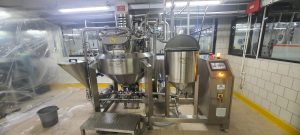


Honey is one of the more demanding products to fill. It is viscous, it can crystallise over time, and it is sensitive to heat and moisture. A filling machine for honey has to deliver accurate doses without drips, handle the product at a controlled temperature and fit the container format you sell. This guide covers the main filling methods, the factors that matter when choosing equipment and how to protect honey quality on the line.
Al Hariri Group is among the leading manufacturers of filling and packaging equipment in Turkey. We supply filling systems for viscous products to customers in the Gulf, Europe and Turkey, and we can recommend a configuration based on your container and output.
Why honey needs specialised filling
Honey flows slowly at room temperature and thickens or crystallises as it sits. For this reason, many honey lines use heated or jacketed hoppers and tanks to keep the product at a stable, workable temperature. Overheating should be avoided, because excessive heat can darken honey and affect its natural character.
Nozzles that stop cleanly are also important. Honey strings and drips easily, so anti-drip or shut-off nozzles help keep containers and the machine clean.
Main filling methods
Piston fillers are widely used for honey in jars and bottles because they measure accurate volumes, even for thick products. Gravity fillers with heated tanks can work for more fluid honey and simpler, lower-speed operations.
For squeeze packs, sachets and stick packs, the filling is usually integrated into a form-fill-seal machine, which forms the pack, fills it with honey and seals it in one continuous process.
Capacity and container range
Semi-automatic machines suit small producers and new brands, while fully automatic lines suit larger production runs. Changing from one jar or bottle size to another usually requires replacing nozzles and adjusting the dosing settings, so it is worth checking how quickly changeovers can be made if you sell several sizes.
Plan the line around the container type first, then the output per hour, since these decisions determine the filling head and conveyor configuration.
Protecting honey quality on the line
Good quality depends on controlling temperature, avoiding air bubbles and keeping moisture stable. De-aeration of the honey before filling reduces foam and improves appearance. Keep records of filling temperatures and batch details to support traceability.
Clean-in-place systems and sanitary stainless steel surfaces help maintain hygiene between production runs.
Line layout and packing
A complete honey packing line usually includes the filling machine, capping, labelling, checkweighing and cartoning. Consider how the line connects to upstream storage and downstream packing so that operators can work efficiently and product flow stays smooth.
Frequently asked questions
Can one machine fill honey and other pastes?
Piston fillers can often handle honey and many pastes, with the right nozzles and settings. The suitable configuration depends on viscosity, particle content and container type.
Why is honey heated before filling?
Gentle heating keeps honey liquid enough to flow accurately into containers and reduces crystallisation in the filling system. Temperature should be controlled carefully so the product is not overheated.
Does Al Hariri Group supply honey filling systems?
We supply filling systems for viscous products and can recommend a configuration for honey based on your container size, required output and filling method.
Blog Posts
Honey Filling Machines: Options for Jars, Bottles and Sachets
Mayonnaise Production Lines: Machines, Process and Quality Control
Date Syrup Production Line: Machinery, Process and Plant Setup
Al Hariri Group Virtual Showroom: Explore Filling and Food Processing Machines Online
Al Hariri Group 2024 Products Catalogue: Filling, Packaging and Processing Range
Meat Processing Machines by Al Hariri Group: A Range Overview
Recent Products
Technical Industrial Porcelain Floor Tiles for Heavy-Use Areas
HFM-4000 Hamburger and Meatball Forming Machine
CTR 60 Kuter Meat Mixer for Small-Scale Producers
Flow Surveillance Glass with Welded Stainless Pipe Connection
Dairy Product Production Equipment
STS Hygienic Twin Screw Pump
DIN 11851 Liner Part, Stainless Steel
Plate and UHT Continuous Pasteurizer for Juice and Milk
316 Stainless Steel Fittings, BSP Types